

Regulatory Efforts
For decades, apparel brands have sought to evade responsibility for the widespread labor rights abuses impacting the workers who make their clothes by attempting to distance themselves from the harms often caused by their own purchasing practices.
Binding agreements and new laws are shifting global labor accountability from voluntary commitments to enforceable standards.
Corporations have relied on voluntary commitments and third-party auditing schemes that fail to prevent rights abuses in their supply chains. Much of the work of rights groups has focused on dismantling brands’ ability to utilize the excuse that they do not directly employ these workers—work that is now echoed in the growing push for human rights due diligence laws and other legislation to hold brands accountable.
Brands themselves have standards in place concerning the working conditions of their suppliers. Today, all major brands and retailers have a code in place, many for well over two decades. A significant problem is that, since these codes are voluntary, they do not entail binding obligations on the brands, themselves. Brands’ own pricing and purchasing practices usually send an opposite message to suppliers: above all else, brands want the lowest priced product on fast delivery, meaning brands will turn a blind eye to wage theft, excessive hours, dangerous factories, and repression against the workers and unions who seek to improve the conditions.
Moreover, most brands source from countries with authoritarian regimes and restricted civic space, where weak labor law enforcement is common. Instead of ensuring suppliers respect national labor laws or recognizing how authoritarianism erodes independent labor and judicial systems, brands often exploit these conditions to avoid accountability.
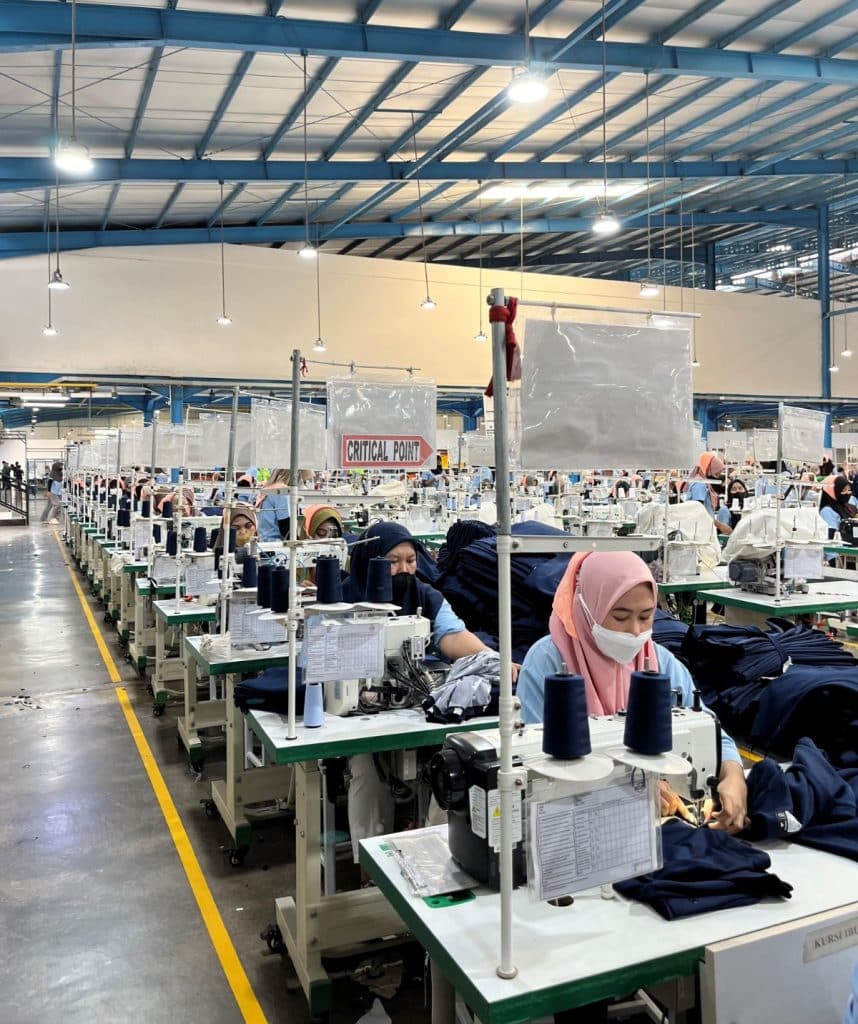
From Voluntary Promises to Enforceable Protections
In response, the Worker Rights Consortium has advanced binding agreements that compel brands to act. These agreements draw on our model of binding labor codes that apply to the production of US collegiate apparel. Notable examples of these agreements include the Bangladesh Accord on Fire and Building Safety and binding Gender Justice Agreements in Lesotho and Indonesia. These frameworks create enforceable obligations for corporations, independent complaint mechanisms for workers, and real consequences for violations.
At the same time, governments are beginning to strengthen corporate accountability through legislation. The European Union has adopted the Corporate Sustainability Due Diligence Directive (CSDDD), part of a broader legislative package requiring companies to identify, prevent, and remedy labor rights abuses linked to their global operations. In the US, the Uyghur Forced Labor Prevention Act prohibits the import of goods made wholly or in part in Xinjiang, placing the burden on companies to prove their supply chains are free of forced labor. Canada and other jurisdictions have introduced similar forced labor and due diligence laws.
These developments mark a shift away from voluntary responsibility toward enforceable regulation. Expanding the scope and strength of such mechanisms remains essential to ending systemic exploitation in global garment supply chains.
Binding Agreements
Binding agreements are legally enforceable contracts that compel brands and factories to meet specific obligations, with clear economic consequences for supplier non-compliance. Unlike voluntary codes, workers and their representatives are at the centre of driving monitoring, enforcement and remediation ensuring rights are upheld in practice.
The WRC forged this model as the independent monitor of binding university labor codes in US collegiate supply chains. By including labor standards in binding licensing contracts, universities ensure that violations detected by the WRC must be remedied, since inaction risks the loss of lucrative contracts. This approach set a new precedent for enforceability in a sector long dominated by non-binding pledges.
Building on that foundation, the WRC has helped secure and is a signatory of industry-wide agreements such as the Bangladesh and Pakistan Accords on Fire and Building Safety, and Gender Justice agreements in Lesotho and Indonesia. These agreements establish enforceable protections against workplace hazards and gender-based violence respectively, safeguard freedom of association, and guarantee workers independent channels to report violations with trust that they will be addressed.
Binding agreements have delivered concrete remedies — from life-saving safety renovations to the eradication of gender-based violence and harassment — showing that enforceability is essential to protecting workers’ rights.
Related pages


JOIN OUR NEWSLETTER
Sign up to the WRC’s mailing list to stay updated on our work.