A Wealthy Industrialist Stole $5 Million from Thai Garment Workers and Refuses to Pay It Back. Leading Apparel Brands Keep Doing Business with Him Anyway.
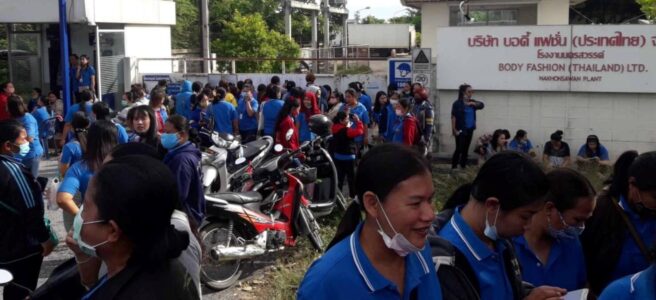
Industrialist Robert Ng deprived 900 low-wage workers at his Thai production facility of $5 million in legally mandated compensation. Five years later, he still refuses to pay workers the money owed to them. His recalcitrance is being enabled by leading apparel brands and retailers in the US and Europe that continue to reward him with business deals, apparently indifferent to the plight of workers’ destitute families. Meanwhile, none of the brands whose clothes were produced at the factory and which directly benefited from the affected workers’ labor—Victoria’s Secret, Lane Bryant, and Triumph—have taken sufficient action to help these workers.
Ng closed his Thai factory, Body Fashion Ltd., in 2020. Thai law mandated that his company pay the workers $4.8 million in severance and other terminal compensation. Multiple court rulings in Thailand affirmed workers’ legal right to this compensation. Ng paid the workers nothing. With legally mandated interest, the total these workers are owed is now $7.6 million. The WRC’s full report on Robert Ng’s responsibility for the wage theft at Body Fashion can be found here.
Ng Is Well Resourced, with Business Holdings Worldwide, and Can Afford to Pay the Workers in Full
Robert Ng, also known as Ng Man Choong,* is a business owner of Malaysian nationality, with residences and business holdings on three continents. These include the underwear brands HOM, SKINY, HANRO, Gossard, and HUBER Bodywear; a network of 60 retail shops across Germany and Austria, and additional retail outlets in the United States, France, Italy, and the United Kingdom; and garment factories in China, Sri Lanka, Portugal, and Hungary; as well as other enterprises.
Ng’s network of privately-owned businesses is byzantine in its complexity, and it provides limited public transparency. However, mandatory corporate filings show multiple entities, 100%-owned by Ng, with net assets in the tens of millions of dollars, including Huber Holding, one of Austria’s top apparel companies.
Given the breadth of Ng’s holdings, and given what is indicated by the financial data on his companies that are publicly available, it is safe to assume that Ng has the resources to pay the Body Fashion workers the money he legally owes them. Notably, he has not, at any time in the five years since the factory closed, cited financial limitations as a reason for his failure to pay.
Prominent Brands and Retailers, Apparently Indifferent to Ng’s Lawlessness, Continue to Enrich and Enable Him with Ongoing Partnerships
Despite the notorious theft of his Thai workers’ wages, Ng has also found numerous willing retail partners to sell his products, including large department store chains and digital platforms. In the United States, his HOM brand is sold at Macy’s, HANRO at Walmart, and both brands at Nordstrom. Amazon carries hundreds of products from Gossard, HANRO, HOM, and SKINY, which it sells to consumers in numerous countries. In Austria, the retailers that partner with Ng include OTTO, Kastner & Öhler, Peek & Cloppenburg, and SiNN. In Germany, they include GALERIA and Zalando.
Ng also owns approximately 10 factories, via a web of holding companies registered in Hong Kong, producing for well-known apparel brands.
Ng’s factories in the Sri Lankan locales of Dambadeniya, Rajanganaya, Veyangoda, and Watawala supply the US brands Abercrombie & Fitch and Lands’ End, the French company Babolat, the British retailer Marks & Spencer (M&S), and Retail Apparel Group in Australia (part of the large South African retail chain TFG).
Ng’s factories in Sri Lanka operate under the umbrella of Courtaulds Clothing Lanka (Ng acquired Courtaulds, including its Pretty Polly brand, from Sara Lee in 2006). An Ng-owned Courtaulds facility in Sri Lanka, Interfashion (Pvt) Ltd., supplies the British retailer Next. Next is also a buyer from PD Clothing & Textiles (Zhongshan) Ltd., Ng’s apparel factory in China, which also supplies the New Zealand outdoor retailer Macpac.
In Hungary, Ng owns Body Fashion (Magyarország) Kft., and, in Portugal, he owns Huber Tricot Confecções Lda. These facilities supply apparel to the Huber Holding underwear brands, allowing them to make “made in Europe” claims for their products. (For example, HUBER Bodywear states on its website: “100% of our entire men’s collection is already produced in Europe. Only a small portion of our women’s daywear is still missing. We are striving to increase this percentage as well.”) Finally, Arula, Ng’s textile factory in Austria, produces fabric for his own company’s brands, as well as for other brands.
If any appreciable number of Ng’s brand and retail partners, all of which purport to care about the rights of workers and the rule of law, told Ng that their partnership with him is contingent on his remedying the theft of the Body Fashion workers’ wages, it is virtually certain that he would. Seven million dollars is a comparably small price to avoid the permanent loss of revenue from these partnerships. It is only the failure of these brands and retailers to hold Ng accountable that enables him to enrich himself, flout the law, and consign 900 families to economic ruin at no cost to himself or his enterprises.
Brands Have a Responsibility to Provide Remedy When Their Supplier Refuses to Meet Obligations to Workers
Five years since the violation of workers’ rights, not a single brand has compelled Ng to remedy the violation or contributed themselves to compensation for the Body Fashion workers.
Prior to publishing our investigation report in December 2023, which detailed our findings of violations of Thai law and buyer codes of conduct at Body Fashion, we contacted each of the brands whose clothing was produced at the factory prior to its closure. Lane Bryant, and the private equity firm Sycamore Partners that owns the brand, failed to respond to our communications. Triumph replied; however, in defiance of its own code of conduct, through which it pledges to protect the rights of workers in its supply chain, Triumph denied any responsibility to address the violations at Body Fashion. Victoria’s Secret responded, acknowledged the violations, and assisted in efforts to contact Ng. However, these efforts have proven fruitless, and, to date, Victoria’s Secret has taken no other action to assist the workers.
The brands and retailers that do business with Ng today also bear a burden of responsibility. With the exception of the brands Ng owns himself, like HUBER Bodywear, none of the brands and retailers currently sourcing from Ng’s factories, or serving as retail outlets for his products, were buyers at Body Fashion. However, all of these companies are benefiting from their partnerships with Ng, which they formed and choose to maintain, even as Ng continues his lawless refusal to pay his Thai workforce the money they earned and desperately need. All of these brands and retailers have leverage over Ng. All of them purport to expect ethical practices from their supply chain business partners. These brands and retailers can, and should, condition further business with Ng on full payment for the Thai workers and their families.
We previously contacted two brands—Abercrombie & Fitch and Marks & Spencer—that were sourcing from factories owned by Robert Ng. Abercrombie & Fitch has never responded. Marks & Spencer did not respond for more than a year; it now says it is contacting Ng. We have further investigated Ng’s current brand and retailer partnerships and have identified additional business partners, as illustrated in the diagram above. We have contacted many of these companies urging them to take action to hold Ng accountable and aid his former workers in Thailand. We will report in the future on their responses. When a factory owner cannot be compelled to pay legally mandated terminal compensation to employees, this is almost always because that owner is bankrupt or is no longer doing business in the apparel industry and is, therefore, not subject to the leverage of industry partners. The WRC is unaware of any recent case, other than this one, in which an owner of a factory that has stolen large sums from workers: (1) possesses the resources to pay the workers but refuses to do so, and (2) despite this, continues to operate actively in the industry and to maintain ongoing partnerships with prominent apparel brands and retailers.
Amidst Long Wait for Their Severance Pay, Body Fashion Workers Subjected to Crushing Debt and Hardship
Last month the WRC spoke with women who had worked for more than two decades at the Body Fashion facility in Nakhon Sawan and were denied severance when the factory closed.
Prasit Koedphithak started working at Body Fashion when she was 21 years old, and she worked there for 22 years. According to court rulings, she was originally owed 419,726 baht in severance, wages, and bonuses. Adding the legally due interest, the amount she is now owed is 711,541 baht ($21,915), the equivalent of more than five years of wages for a Thai garment worker.
“I gave everything to that factory, and I never got the chance to learn other skills,” Prasit said. “If you ask how hard life is, I’ve never had it this bad. Even when I was a kid and didn’t have much, it was never this bad. I’m old now, and there are no options left… I don’t see a future for myself anymore. Sometimes I don’t even want to go home because I’m afraid creditors will come yell at me. It’s been five years of this. It’s like a nightmare I never wake up from.”
In her last year of working at Body Fashion, Prasit was supporting her disabled aunt and her one-year-old son. She can no longer support any of her adult relatives, and she has sent her son to live with her parents. Recently, her brother died, and his children now live with her. She is struggling to afford food for them.
Jaruwan Karak worked at Body Fashion for 24 years, and her husband worked there for 21 years. Together they were originally owed a total of 878,517 baht, according to court orders. Adding the legally due interest, the amount they are now owed under Thai law is a total of 1,472,787 baht ($45,362), the equivalent of more than 10 years’ wages. Prior to being terminated from the factory, they had not been able to accumulate any savings, because their wages were too low to make that possible. Their water and electricity have been shut off in their home, because they couldn’t keep up with the payments, and their motorcycles have been seized.
“I had no money, so I borrowed from everyone possible, until no one would lend to me. So, finally, I had to borrow money from loan sharks,” Jaruwan said, shedding tears. “I have to pay them every day. Now, I owe them about 50,000 to 60,000 baht in debt. With interest, it is more than 100,000 baht. There are some days when I cannot pay, and they will come and threaten me in front of my shop.”
Jaruwan worries that her house will be seized this year. Her son has already been expelled from his university twice over unpaid tuition. “My husband and I don’t eat three meals a day. Some days we only have one. We have to support our children first.”
When asked what she would have done with her severance, if Ng had paid it when it was originally due to her at the time of the factory closure, Prasit said: “I would have used it to open a small shop. With enough capital, I could have rented a place in a good location and run a sustainable business. I could support myself. … Without [that] capital, I couldn’t move forward.”
“If I receive my compensation, I will divide it into three parts: to pay off my debts, to pay for school for my children, and to keep us fed and clothed,” Jaruwan said.
A Note on Legally Mandated Interest
The amount of compensation legally owed to the Body Fashion workers continues to grow. Under Thai law, 15 percent interest accrues for each year of nonpayment of terminal compensation. In the cases on the nonpayment of bonuses, Thai courts ruled that the former Body Fashion workers are owed 7.5 percent interest for the first year of nonpayment and five percent for each subsequent year. All told, five years since July 31, 2020, the date when most of the Body Fashion workers were dismissed, the former employees of Body Fashion’s sewing factory in Nakhon Sawan and Body Fashion’s small sample-making facility in Bang Pla are owed a total of 245,471,972 baht ($7.6 million at current exchange rates), 96,231,404 ($3 million) of which is interest.
There is precedent in Thailand of securing high sums of severance owed to garment workers, long after this was legally due to them. The Brilliant Alliance lingerie factory, which had previously been part of Body Fashion when both factories were under the ownership of the Swiss company Triumph International, closed in March 2021. After a year-long international advocacy effort, the Brilliant Alliance workers received the 281 million baht they were owed ($8.3 million at the time). Victoria’s Secret had agreed to finance the payments via a loan arrangement with the workers’ former employer.
* Robert Ng (Ng Man Choong) has no relation to Robert Ng Chee Siong, Chair of Sino Group.
Join our newsletter
Sign up to the WRC’s mailing list to stay updated on our work.